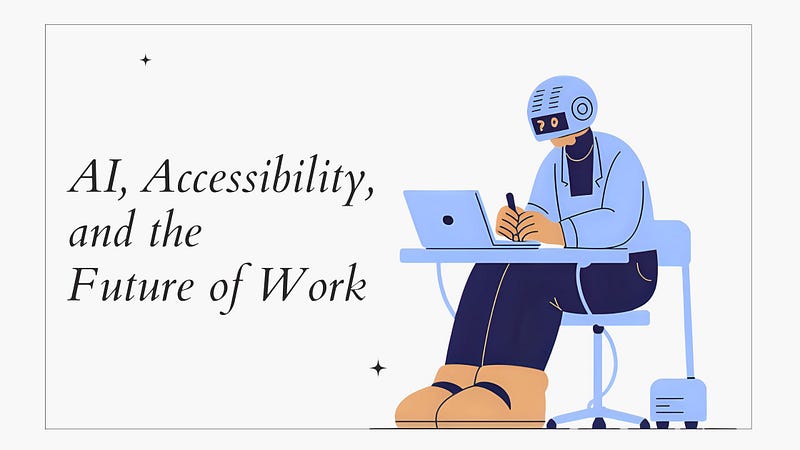
AI, Accessibility, and the Future of Work
How AI reshapes workplace accessibility and why technical writers make it real.
Artificial intelligence is changing the workplace in ways we couldn’t have imagined a decade ago. But the most important shift isn’t automation, efficiency, or productivity; it’s accessibility. Artificial Intelligence is helping create workplaces that are more inclusive, more human, and more equitable.
From real-time captions to adaptive interfaces, AI is lowering barriers for people with disabilities, neurodivergent thinkers, non-native speakers, and anyone who needs a different way of interacting with technology. And at the heart of this transformation are technical writers, the people who translate complex artificial intelligence capabilities into language that users can understand and trust.
While we have been talking a lot about Artificial Intelligence and its effects on Tech writers’ lives, let’s also explore how AI is powering workplace inclusion, the tools making a real impact today, and why technical writers are now essential to building accessible digital experiences.
AI is expanding accessibility in practical and everyday ways.
Real-time captioning and transcription
One of the most impactful ways AI supports accessibility is through live transcription. Some of the tools that provide real-time captions and searchable transcripts are:
- Microsoft Teams Live Captions
- Zoom AI Companion
- Google Meet Captions
- Otter.ai
According to the Intapp 2025 Technology Perceptions Report, 72% of professionals now use AI at work, and transcription is one of the most widely adopted use cases. It is helpful to:
- Deaf and hard-of-hearing employees
- Non-native English speakers
- Employees attending meetings in noisy environments
- Anyone who processes information better through reading
For technical writers, AI-generated transcripts are a goldmine. They can be refined into meeting summaries, documentation drafts, feature announcements, or training guides.

Adaptive interfaces make digital tools fit the user
AI-powered adaptive interfaces empower employees to customize their interactions with technology based on their needs.
Some of the most well-known interfaces are:
- Microsoft Immersive Reader, which adjusts spacing, layout, and readability
- Windows 11 Narrator, with intelligent, AI-driven voice navigation
- Notion’s AI Focus Mode, which reduces clutter for neurodivergent users
- Auto-contrast and vision modes in macOS and Android
These are helpful to:
- People with ADHD
- People with dyslexia
- Users with low vision or motor impairments
- Anyone who benefits from simplified displays
For technical writers, this means designing content that works seamlessly across assistive technologies. This includes semantic structure, descriptive headings, accessible tables, and robust alt text.
AI accessibility checkers, such as Accessibility Insights, Axe, or WAVE, help writers verify that their content is screen-reader-ready.
AI writing tools are making content more inclusive
We have spoken about this a lot, and I repeat again: Artificial Intelligence is not replacing writers, it’s enhancing their ability to write clearly, inclusively, and at scale.
Here are some of the tools making a real difference:
- Grammarly Business: clarity, inclusive language, tone checks
- Microsoft Editor: bias detection, accessibility-focused suggestions
- DeepL Write: high-accuracy rewriting and translation
- GPT-based tools (ChatGPT, Claude, etc.): explanation, simplification, summarization
- Hemingway Editor: readability improvements
A real example:
A technical writer supporting a global SaaS product can use:
- ChatGPT to turn complex engineering notes into user-friendly instructions
- DeepL to produce accurate Spanish, French, and Hindi translations
- Microsoft Editor to check for inclusive, bias-free language
- Grammarly to refine tone and readability
The result? Documentation that welcomes users rather than excluding them.
If not, you can simply use your in-house or integrated tools. For example, we use Microsoft Copilot in our organisation. It helps as a one-stop assistant to refine our content, create a chunk of documentation, understand features, translate, and check for accessibility.

Artificial Intelligence as an assistant to writers
Automatic alt text generation
Tools like Adobe Firefly and Canva, and research models like AltGen, can generate descriptive alt text for images, reducing manual effort and ensuring consistency.
Captioned and transcribed videos
Tools such as Descript, YouTube Auto-Captioning, and Teams Recording Summaries generate accurate captions and transcripts for training videos and tutorials.
Audio-based help content
Platforms like ReadSpeaker and Murf.ai allow teams to convert technical documentation into audio guides, supporting users who prefer or require spoken content.
Accessibility-centered coding support
A 2025 academic paper, CodeA11y, shows how GitHub Copilot can guide developers toward accessible HTML by suggesting ARIA roles, alt attributes, and semantic tags. Technical writers can integrate such tools when producing developer documentation.
AI reduces bias and improves inclusive language.
Workplace language matters. It influences who applies to jobs, how welcome users feel, and whether people understand instructions.
Tools like Textio, Microsoft Editor, Grammarly Business, and many more flag biased, gendered, or non-inclusive language.
Example:
A job description that says “We’re looking for a coding rockstar” may discourage female or neurodivergent candidates. Textio suggests replacing it with neutral language, such as “software engineer.”
Technical writers help organizations adopt inclusive communication standards, and AI makes this easier and more consistent.

Why are technical writers essential to AI-driven inclusion?
AI can generate text, analyze language, and detect accessibility issues, but it cannot replace the human skill of writing with empathy, clarity, and purpose.
Technical writers can:
- Translate AI accessibility features into clear instructions
- Create documentation that works for assistive technologies
- Train teams to use AI responsibly
- Develop inclusive style guides
- Review AI-generated content for accuracy and bias
- Advocate for users whose needs are often overlooked
This makes writers not just content producers but inclusion leaders.
How technical writers can start leading AI + accessibility today
Here are practical steps you can take immediately:
- Audit existing documentation: Use AI accessibility checkers to find issues with alt text, structure, contrast, and readability.
- Standardize AI-supported alt text: Use tools like Firefly or Canva to generate descriptions, then refine them manually.
- Create plain-language versions: Use AI summarization to create simplified guides for users who prefer clear, direct language.
- Caption and transcribe everything: Training videos, tutorials, and demos should always have AI-generated captions and transcripts.
- Partner with product and engineering: Work with teams to integrate accessibility early, especially using tools like Copilot or Axe.
- Maintain an inclusive language style guide: Use AI tools to enforce tone, clarity, and bias-free language across content.
- Train others: Host workshops on writing for accessibility and using AI as a support tool.
AI makes all this faster, but the direction comes from you.
The future of work is accessible if we build it that way.
AI is redefining work, but its most significant power is in expanding who gets to participate fully. When used thoughtfully, AI doesn’t replace human capability; it enhances it.
But tools alone don’t create inclusion.
Writers do.
Technical writers bring the clarity, empathy, and structure that turn AI features into real-world accessibility. The future of inclusive workplaces will be built by the people who write the instructions, shape the language, and ensure every user is seen.
Disclaimer: This post may contain affiliate links. If you click and buy, we may receive a small commission at no extra cost to you. Read our full disclosure here.