

Did OTT Solve the Cable Problem or Just Created a New One?
It promised freedom, but delivered 8 bills and 5 passwords.
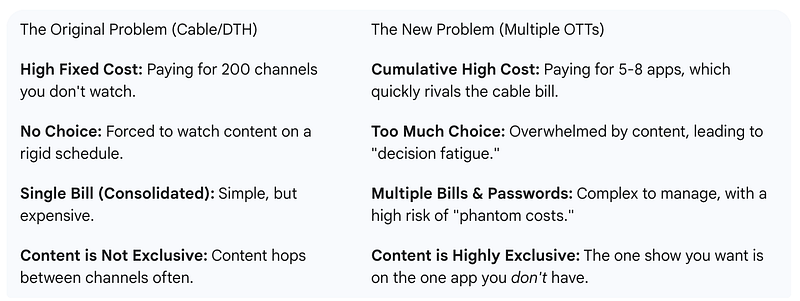
When Netflix and its early peers arrived, the promise was simple: Freedom and Affordability. Cut the cord, ditch the outrageous cable bill full of 200 channels you never watch, and pay one low, fixed price for all the entertainment you could stream.
It was the perfect solution to the “Cable Bloat” problem.

Fast-forward to today, and the landscape is unrecognizable. Every major studio, broadcaster, and regional player has launched its own platform. We now have Netflix, Amazon Prime Video, Disney+ Hotstar, SonyLIV, ZEE5, Lionsgate Play, JioCinema, and a dozen more, all with their own exclusive “must-watch” content.
The result is the new challenge: Subscription Fatigue.
Did OTT solve the problem of high cable costs, or did it just replace it with a new, equally frustrating one?
The answer is nuanced. OTT solved the problem of choice, but created a new one of cost and management.
The Problems OTT Solved
Despite the rising costs, OTT did not fail completely. It fundamentally changed the value proposition for the consumer in three crucial ways:
- Eliminated Unwanted Content: Unlike cable, where you pay for channels like Golf when you only want Cricket, the OTT model allows you to subscribe purely to the content you value. The cost is now tied to desire, rather than being part of a mandatory broadcast bundle.
- Delivered Unprecedented Freedom: OTT cemented the on-demand and portable viewing model. The ability to pause a show on the TV and resume it on your phone, or binge-watch an entire season on release day, is a freedom cable simply could not match.
- Fostered Global and Niche Content: The hyper-fragmentation led to an explosion of unique, high-quality, and niche content (regional language shows, documentaries, international series) that would never have been commissioned for mass-market cable TV.
The New Problem: Subscription Fatigue and ‘Phantom Costs’
The core pain point today is not just the high cumulative cost, but the sheer management effort and mental burden:
- The Hidden Expense: Individually, a ₹199 or ₹299 per month plan seems negligible. But once you subscribe to five of them, the total can easily exceed a premium DTH package, creating a huge “phantom cost” that sneaks up on the household budget.
- The Management Headache: Juggling multiple apps, separate user interfaces, different log-in credentials, and tracking varying annual or monthly renewal dates is simply exhausting.
- Content Hopscotch: To watch everything popular — from a Netflix original to a SonyLIV sporting event to a Disney+ Hotstar movie — you are forced to subscribe to all of them.
The Future is in Aggregation: The Counter-Revolution
The market is already responding to the pain it created. The new solution to Subscription Fatigue is the very model we see players like OTTplay pioneering: The Aggregator or Super-Bundle.
- Unified Billing: Aggregators offer bundles of 5, 10, or more platforms under a single subscription, often at a significant discount compared to buying them individually. This solves the management headache and the cumulative cost problem.
- Universal Search: These platforms act as a single gateway, allowing you to search for a movie and instantly see which of your bundled services has it, solving the content deviation and discovery problem.
The Analyst’s Take
The initial promise of OTT — one price for everything — was always unrealistic once content became the primary weapon. The industry has now moved through three phases:
- Cable Bloat: Too much money for too little choice.
- OTT Fragmentation: Too much choice for too much effort/money.
- OTT Aggregation (The Current Trend): The market is correcting itself by reintroducing the convenience of the bundle, but keeping the choice and on-demand freedom of streaming.
We are entering a new era where consumers will likely maintain one or two core services (Netflix/Prime) and subscribe to a single, deep aggregator bundle to cover everything else.
This is the ultimate synthesis of the convenience of cable and the choice of OTT.
This evolution in the media landscape reflects a significant shift in consumer behavior and preferences. As the market continues to adapt, the focus will likely be on creating value through streamlined access to diverse content without overwhelming subscribers. The interplay between choice and convenience is set to redefine the viewing experience, potentially leading to a more sustainable model that could benefit both consumers and content providers alike. Thus, while OTT has addressed some of the shortcomings of traditional cable, it has also introduced new challenges that require ongoing innovation and strategic alignment.
Disclaimer: This post may contain affiliate links. If you click and buy, we may receive a small commission at no extra cost to you. Read our full disclosure here.