
Discover the Cost-Saving Secrets of Google Cloud Compute
Preemptive VMs vs Spot VMs in GCP
Google Cloud Platform (GCP) provides various compute options tailored to meet diverse needs. Among these are Preemptive Virtual Machines (VMs) and Spot VMs, which offer cost-effective solutions for running workloads. While they are similar in purpose, they differ in implementation and use cases. This blog explores the key differences between Preemptive VMs and Spot VMs in GCP.
Overview of Preemptive and Spot VMs
Preemptive VMs
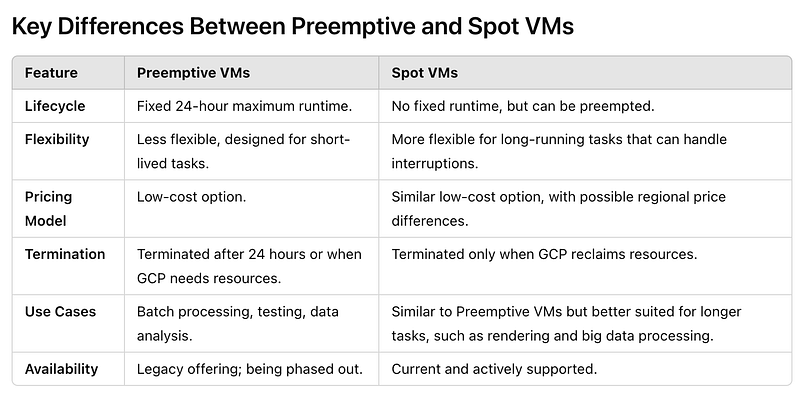
Preemptive VMs were introduced as a cost-saving option in GCP, designed for workloads that can tolerate interruptions. These VMs come with a fixed maximum runtime of 24 hours. If the VM is needed by higher-priority workloads or reaches the 24-hour limit, it is automatically terminated by GCP.
Spot VMs
Spot VMs are the successor to Preemptive VMs, offering similar cost benefits but with increased flexibility. Spot VMs are transient and can be preempted by GCP when resources are required elsewhere. Unlike Preemptive VMs, Spot VMs do not have a 24-hour maximum runtime, making them more suitable for a broader range of workloads.
Use Cases
Both Preemptive and Spot VMs are ideal for workloads that are:
- Fault-tolerant
- Not time-sensitive
- Capable of being restarted without issues
However, Spot VMs are now the preferred choice for most use cases due to their flexibility and longer potential runtime.
Examples of Workloads:
Preemptive VMs:
- Quick testing environments
- Short-lived CI/CD pipelines
Spot VMs:
- Data processing pipelines
- Machine learning model training
- Video rendering tasks
Preemptive VMs and Spot VMs are excellent options for cost-saving in GCP, but Spot VMs are the modern, flexible solution for transient workloads. By understanding the differences and leveraging the right VM type, you can optimize costs and performance for your applications.
Whether you’re running batch processing jobs, testing environments, or large-scale computations, Spot VMs are the go-to choice for transient and interruption-tolerant workloads.
https://rajsm139.medium.com/subscribe?source=post_page—–4bb44fca194e——————————–
Disclaimer: This post may contain affiliate links. If you click and buy, we may receive a small commission at no extra cost to you. Read our full disclosure here.