
How technical writers can fix the LLM “Lost in the Middle” problem.
How to Structure Long Prompts to Prevent the Middle Slump in AI Models!

In my previous blogs, we have already explored the art of crafting powerful prompts. You set a system persona, give clear instructions, and provide helpful context. (If you haven’t, check out our guide on Advanced Prompt Engineering for Technical Writers.
But sometimes, when you feed a Large Language Model (LLM) a lot of information, like an entire design specification or a massive set of release notes, it ignores the single most critical instruction.
This is not a flaw in your writing; it’s a limitation in the model’s attention mechanism. It’s called the “Lost in the Middle” effect, and every technical writer who uses long inputs needs to know how to fix it.
You may also like:
The Core Problem: The LLM’s Working Memory
To understand why this happens, we need to understand the context window.
The context window is the LLM’s temporary working memory. Think of it as a limited notepad where the model keeps the entire prompt — your instructions, the background text, and even the ongoing conversation. Everything the model sees is measured in tokens (a token is roughly a word or a part of a word).
When the context window is full, the model simply cannot give equal attention to every single token. Instead, research shows its attention prioritizes the beginning and the end.
This behavior mimics two well-known human memory effects:
- The Beginning Advantage (Primacy): The model remembers the first items best.
- The End Advantage (Recency): The model remembers the last items best.
- The Middle Slump: Anything you place in the middle is much more likely to be overlooked or forgotten.
If your most important command is buried right in the middle of a 4,000-word source document, the model is likely to miss it and produce a generic or incomplete response.
The Solution: Always End with the Action
The fix is simple. Stop fighting the LLM’s memory bias and start leveraging it. We must structure the prompt to place the most critical information where attention is most likely to be focused.
This means rethinking the intuitive structure. The mistake most people make is placing the core task before the source material, which buries the instruction in the middle of the overall input length.
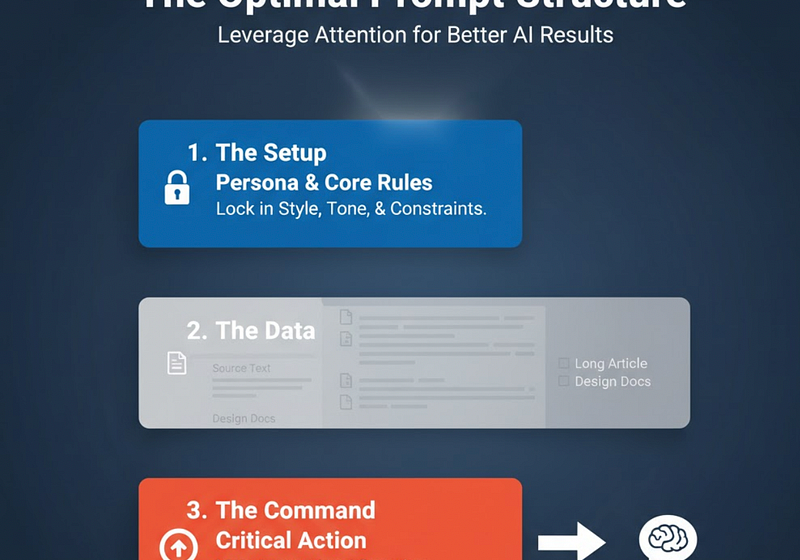
The Optimal Prompt Structure
For any prompt where you include a large block of source text, use this order:

1. The Setup (Beginning Advantage)
Use the first part of your prompt to establish the nonnegotiable standards. This leverages the Beginning Advantage to lock in key behaviors.
- Persona: Define the role and tone. (Example: “You are an expert technical editor who always follows the Microsoft Style Guide.”)
- Core Rules: Set the high-level constraints. (Example: “Always maintain a crisp, helpful, and direct tone. Use second-person pronouns (you, your).”)
- Examples: Provide any necessary few-shot examples that illustrate the desired output format.
2. The Data (The Middle Slump)
This is the content the model must process. This bulk material is what causes the middle slump, but it cannot be avoided.
- Source Text: Insert the long article, document, meeting notes, or code you want the LLM to work with.
3. The Command (End Advantage)
This is the most crucial part. Always put your primary instruction or question here.
- Critical Action: The final words of the prompt should be the specific task. This forces the LLM’s full attention onto the task right before it starts generating the response. (Example: “Based on the text above, extract the five key changes for the next product version and present them as a bulleted list.”)
Actionable Best Practices for Long Prompts
Apply these three rules to ensure your LLM never gets “Lost in the Middle” again:
- Prioritize the Final Command: Put your main command last. The last line of the entire prompt should always be the specific action you want the LLM to perform. This is the single most effective way to leverage the LLM’s memory for your benefit.
- Frontload the Style and Persona: Use the beginning of the prompt to lock in your style guide and persona. Provide clear instructions on how the output should sound and look, then trust that the model will strive to adhere to that style while executing the final command.
- Reinforce and Redundancy for Critical Constraints: If you have one truly nonnegotiable constraint — like a safety warning, legal disclaimer, or a specific formatting rule — state it at the start and repeat it at the end. This doubles the model’s exposure to the rule and dramatically reduces the chance of it being ignored.
You may also like:
Conclusion
By structuring your prompts this way, you shift from simply asking the LLM to process text to engineering its attention, ensuring the most important instructions are always remembered. Ultimately, mastering LLMs isn’t about adapting your work to a flawed machine; it’s about applying the fundamental principles of technical communication — clarity, structure, and audience awareness — to a new kind of reader.
When you respect the LLM’s architecture, your expertly crafted instructions will never be lost in the middle again.
Disclaimer: This post may contain affiliate links. If you click and buy, we may receive a small commission at no extra cost to you. Read our full disclosure here.