

How to Write a Movie Review: A 5-Part Framework
How to provide deep cinematic movie insight without stealing the “joy of discovery” from your audience.
I have a problem. I’m the friend who watches everything, reads everything, and shows up to brunch with a breathless monologue prepared. When I’m excited about a film, I find myself sprinting toward a spoiler just to prove how much I loved it.
I hate spoilers. A spoiler doesn’t just reveal a plot point; it steals the choreography of a film. It ruins the timing of surprise, dread, and relief that a filmmaker spent years perfecting.
To save my friendships (and my writing), I built a framework. It keeps reviews sharp, honest, and analytical while protecting the viewer’s experience. Whether you’re sending a WhatsApp voice note or publishing on Medium, this is how you rave about a film without ruining it.
The Promise: Insight Without Theft
A great review should help a reader decide whether to watch, how to watch, and what to pay attention to — all without revealing the plot machinery.
What counts as a spoiler? It’s more than the “twist.” It’s the late-act reveal, the secret cameo, or the specific choice a character makes when the world is on fire. If a moment was designed to land in the theater, don’t pre-land it for your reader.

The 5-Part Framework (Zero Plot)
1. Orientation (The Compass, Not the Map)
Give the reader their bearings. What is the “vibe” and the central inquiry?
- The World: Era, place, and atmosphere.
- The Question: The theme the film sits with (not the plot it follows).
Example: “Set in a sun-bleached coastal town where silence is a currency, the film asks what honesty costs when your history is a crowded room.”
2. Craft Snapshot (Evidence, Not Hype)
Instead of saying a movie is “good,” point to the choices that made it so.
- Direction: Pacing, visual language, tension.
- Writing: Subtext and dialogue rhythm.
- Performances: Energy, restraint, and chemistry.
Example: “The camera holds a beat past comfortable; the silence starts doing the talking. The dialogue is barbed but never flamboyant.”
3. What It’s Really About (The Core Conflict)
Describe the Want vs. Need conflict without naming the moment of change.
Example: “It’s a study of a person who confuses competence for connection, and the agonizing cost of that mistake.”
4. Texture and Vibe
How does the film sit in the stomach? What is the aftertaste?
- Sensory: Score, sound design, and color palette.
- Comparisons: “If you liked the slow dread of The Witch but wanted the melancholy of Aftersun…”
5. Viewer Fit (Manage Expectations)
Who is this for? Be honest about the “barrier to entry” without giving away events.
Example: “It is gorgeous but patient. If you need constant quips, you’ll fidget; if you like pressure cookers set to low, you’ll feast.”
How to Talk Without Telling: “Stealable” Micro-Phrases
If you find yourself drifting into “recap territory,” swap your plot verbs for sensation verbs.
- Pacing without plot: “Starts like a whisper, tightens like a tourniquet.”
- Theme without reveal: “It asks whether success can survive honesty.”
- Performance without scene: “She plays certainty like a mask with hairline cracks.”
- Ending without detail: “The final beat doesn’t explain; it invites you to decide.”
Common Pitfalls to Avoid
- The “Plot Walk-through”: If your paragraph has more action verbs than descriptive adjectives, you’re recapping.
- Trailer Regurgitation: If the trailer showed it, your reader already knows it. Bring the texture the trailer couldn’t capture.
- Coded Spoilers: Saying “It really comes together in the hospital…” is a spoiler. You’ve just told the reader to wait for a medical emergency. Don’t be that person.
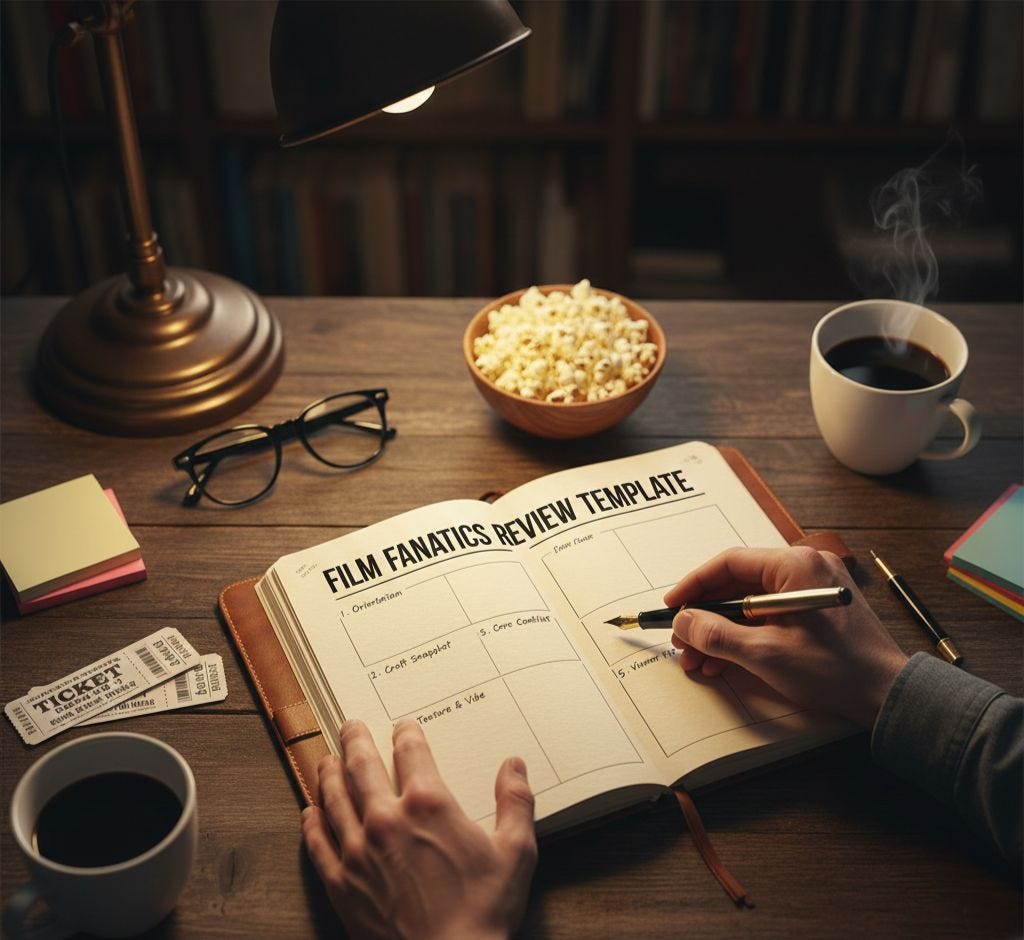
Your Reusable Template
Copy and paste this for your next Letterboxd or Medium post:
Title: [Spoiler-free hook]
Orientation:
- World / Mood:
- The Question:
Craft Snapshot:
- Direction & Style:
- Performances:
Theme: [The ‘Want’ vs. ‘Need’] Texture: [Sound, Color, Rhythm] Fit: [Who it’s for / Who it isn’t for] Verdict: [One-line summary]
Why This Matters
When you protect the timing of a story, you respect both the craft and the reader. But the secret benefit? You’ll start watching differently. You’ll notice composition, rhythm, and subtext. Your own writing sharpens because “craft spotting” is a transferable skill.
Consider this framework a plate that carries the aroma of a great meal without showing the recipe card.
Got a film or series you want me to try this on? Drop it in the comments. I’ll pick one for a spoiler-free review next week and credit you for the suggestion.
Disclaimer: This post may contain affiliate links. If you click and buy, we may receive a small commission at no extra cost to you. Read our full disclosure here.