
Prompt Engineering: A Technical Writer’s Guide to Mastering AI
Frustrated with AI? This blog is dedicated to prompt engineering for technical writers, providing guidance on creating high-quality content that saves you time and frustration.
Have you experienced the frustration of typing a prompt, only to have the AI respond with something you didn’t expect? You tweak the prompt, try again, and after multiple attempts, you wonder whether the AI is even useful. I have been there, and I have learned that the problem is rarely the AI itself. The issue is almost always the prompt.
What Are Prompts, Anyway?
A prompt is simply the instruction you give an AI. It can be a question, a command, or a block of text. But a great prompt is more than just words. It provides context, specifies the audience, and guides the AI on style, tone, and format.
Without clarity, the AI can only guess. That’s why vague prompts produce disappointing outputs. The better you define your prompt, the more likely the AI is to create content that’s accurate and usable.
Unlocking AI’s Potential with Prompt Engineering
Prompt engineering is the deliberate practice of crafting instructions to produce the best possible AI output. It is not about memorizing “magic words.” It’s about understanding how AI interprets instructions and communicating with it effectively.
AI doesn’t read your mind. Even the most powerful models are pattern-recognition systems. They can’t infer your goals unless you spell them out. Good prompt engineering gives the AI a “mini-brain” built around your task. It tells the AI exactly what you need, how you need it, and for whom it is intended. The result is more accurate, relevant, and useful content.
When you understand prompt engineering, you stop relying on guesswork. You can guide AI to produce precisely what you need, saving time, reducing frustration, and transforming AI into a collaborative tool.
Why Accurate Prompts are Important for Technical Writers?
Mastering prompts can turn AI from a source of frustration into a powerful assistant, especially for technical writers. Your job already demands clarity, precision, and audience focus. These are the skills that underpin effective prompt engineering.
Writing documentation requires structuring information clearly, simplifying complex topics, and considering the user experience. Accurate prompts enable you to leverage these same skills in AI-assisted writing. Whether you’re drafting release notes, documenting a feature, or explaining an API, the right prompt ensures the AI produces content that aligns with your professional standards and your audience’s needs.
By understanding the key principles of prompts, you can:
- Draft structured documentation efficiently.
- Generate step-by-step guides and examples.
- Maintain a consistent tone and style.
- Minimize repetitive writing tasks.

A Practical Prompt Playbook for Technical Writers
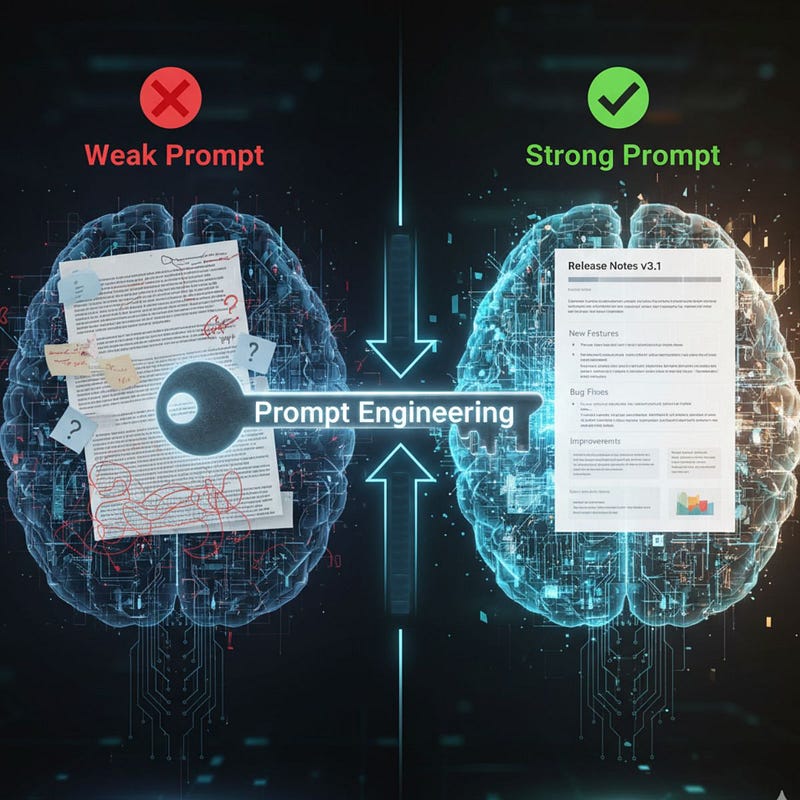
Effective prompts are the key to turning AI into a productive writing assistant. Here’s a hands-on guide comparing weak and strong prompts for everyday technical writing tasks, explaining why the optimized versions work.
Release Notes
- Weak Prompt: “Write release notes for the new version.”
❌ Problem: Too vague; no audience or content guidance.
- Strong Prompt: “Write concise release notes for version 3.1 of our project management software. Highlight new features, bug fixes, and performance improvements. Keep it under 200 words and use plain language suitable for end-users.”
✅ Why it works: Specifies the version, content focus, audience, and word limit.
Feature Descriptions
- Weak Prompt: “Describe the new analytics dashboard.”
❌ Problem: No context, audience, or style guidance.
- Strong Prompt: “Describe the new analytics dashboard in our SaaS product. Explain how users can track project performance, create custom reports, and filter data. Use clear, beginner-friendly language for non-technical users and keep it under 150 words.”
✅ Why it works: Adds context, audience, style, and length constraints.
API Documentation
- Weak Prompt: “Document the API endpoint for creating users.”
❌ Problem: Lacks detail, structure, and audience specification.
- Strong Prompt: “Document the REST API endpoint for creating new user accounts. Include request format, required parameters, response examples, error codes, and usage tips. Write for developers with basic coding experience and format it as a reference guide.”
✅ Why it works: Structured, audience-focused, and comprehensive.
Troubleshooting Guides
- Weak Prompt: “Write troubleshooting steps for login issues.”
❌ Problem: No structure, audience guidance, or detail.
- Strong Prompt: “Create a step-by-step troubleshooting guide for users facing login issues in our mobile app. Include common errors, solutions, and tips for avoiding problems. Write in simple language suitable for non-technical users and number each step clearly.”
✅ Why it works: Structured, audience-focused, and easy to follow.
Key Principles for Strong Prompts: Your SEO Checklist
To ensure your prompts deliver, remember these core principles that mirror on-page SEO best practices:
- Context: Provide the AI with relevant details (e.g., product, version, or feature).
- Audience: Specify who will read or use the content.
- Structure & Style: Define the tone, format, and word limits.
- Constraints: Include any limits on length, depth, or examples.
- Iteration: Treat AI output as a draft to refine through multiple prompts, just as you would with a human editor.
My Personal Journey with Prompt Engineering
I won’t pretend I became an expert overnight. I went through a lot of trial and error, rewriting prompts dozens of times before getting results I was satisfied with. Over time, I realized that each AI agent behaves differently. What works for ChatGPT may need adjustment for Gemini, and vice versa.
I experimented extensively, researched techniques, and took courses on the subject. With practice, I learned to refine my instructions, anticipate AI behavior, and iterate efficiently.
Today, AI has become a reliable tool in my workflow for tasks such as documentation, blogging, image creation, and brainstorming. The more precise and contextual my prompts, the better the results.
Every project gives me new insights and helps me refine my skills.
Conclusion: Transform Your Workflow with Accurate Prompts
Mastering prompts is the key to unlocking AI’s full potential for technical writing. With clear, well-structured prompts, you can guide AI to produce accurate, readable, and audience-focused content.
Remember these essentials:
- Be specific: Provide context and relevant details to support your claims.
- Know your audience: Tailor the language, tone, and complexity to suit your audience.
- Structure and guide: Define the format, style, and constraints to ensure consistency and coherence.
- Iterate: Treat the AI output as a draft and refine your prompts until the results meet your standards.
By approaching AI with deliberate, thoughtful prompts, you transform it from a frustrating tool into a reliable writing partner, helping you save time, reduce repetitive work, and maintain high-quality documentation.
Disclaimer: This post may contain affiliate links. If you click and buy, we may receive a small commission at no extra cost to you. Read our full disclosure here.
