
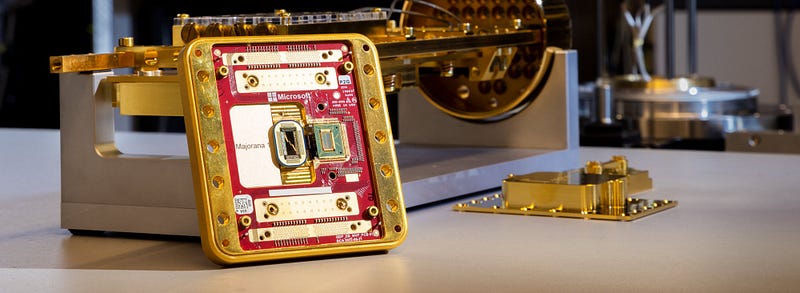
Majorana 1: Microsoft’s Breakthrough in Quantum Computing
The Future Of Technology?

Imagine a world where problems that stump even the most powerful supercomputers could be solved in seconds. It sounds like something out of an Avengers movie, right? Well, if Tony Stark had a secret weapon beyond his Jarvis, it might just be quantum computing. And Microsoft just assembled their own quantum superhero — the Majorana 1 chip.
This isn’t just another tech buzzword; it’s a game-changing quantum processor powered by a new type of qubit (quantum bit) called a “topological qubit.” It promises to be faster, stronger, and more reliable.
What Is Quantum Computing?
I had to do my due research for this blog and realized I should first introduce quantum computing. In simple terms, regular computers, like the one you may be reading this on, think in binary — they use bits that can be either 0 or 1. But quantum computers are like Doctor Strange bending the laws of reality; they can exist in multiple states at once. This means they can process a mind-boggling number of possibilities simultaneously.
They use qubits, which, by a principle known as superposition, can simultaneously represent 0, 1, or both. Due to this unique capability, quantum computers can do intricate computations significantly faster than classical computers. This also makes them perfect for solving ultra-complex problems like modeling molecules or optimizing global logistics.
Why Was Majorana 1 Created?
As cool as quantum computing sounds, it has a major flaw: qubits are ridiculously sensitive. Small vibrations or temperature shifts can mess up their calculations.
Thus, Microsoft’s Majorana 1 quantum processing unit (QPU) was created to improve the stability and reliability of these quantum computers. It uses Majorana fermions, a unique qubit first theorized by scientist Ettore Majorana in 1937. These particles are known as topological qubits. These are more stable and continue to produce accurate calculations throughout time. A long-standing objective in the field is to develop scalable, fault-tolerant quantum computers, and the Majorana 1 chip represents a breakthrough in that direction.
The Science Behind Majorana 1: Magic or Physics?
These mysterious Majorana fermions are at the heart of Majorana 1. Imagine them as quantum bodyguards that protect qubits from chaos.
Regular qubits are fragile because their information is stored in a single location. But topological qubits, like those in Majorana 1, spread that information across multiple points. Even if one part is disturbed, the rest remain intact. This makes them incredibly robust against errors—a major breakthrough in quantum computing.

The Journey to Majorana 1: From Sci-Fi to Reality
Microsoft didn’t build this overnight. For over 20 years, their scientists have been on a mission to tame the quantum beast. They started by theorizing the existence of Majorana fermions, then collaborated with physicists to prove they were real. Once they cracked that mystery, they built the Majorana 1 chip, the first working processor to harness these elusive particles.
It’s a milestone that began in theoretical physics and culminated in a chip that could change the world. Majorana 1 represents a scientific achievement and a commitment to advancing computing capabilities for real-world applications.
Technical Innovations of the Majorana 1 Chip
So, what makes Majorana 1 unique?
The Majorana 1 chip is more than a theoretical breakthrough — it is an engineering marvel. The chip incorporates topoconductors to stabilize Majorana fermions, allowing for the creation of topological qubits. This approach offers key advantages over traditional qubit architectures:
- Error Resistance: Topological qubits naturally resist decoherence, reducing the need for complex error correction mechanisms.
- Scalability: The Majorana 1 chip provides a foundation for building large-scale quantum processors capable of handling millions of qubits.
- Efficiency: Majorana 1 can devote more processing power to solving complex problems and fewer resources to error correction.
Applications of Majorana 1: Saving the (Tech) World
What could we do with a quantum computer powered by Majorana 1? Here are some real-world applications:
- Materials Science: Imagine designing new materials at the atomic level for better batteries or stronger spacecraft.
- Cryptography: Create encryption so strong that even the smartest hackers won’t break it.
- Optimization: Solve complex problems like traffic flow or supply chains with unimaginable speed.
- Pharmaceuticals: Simulate molecular structures to accelerate the discovery of new drugs.
Microsoft’s Quantum Disruption: Changing the Game
With Majorana 1, Microsoft isn’t just joining the quantum race — it’s redefining it. While others struggle with unstable qubits, Microsoft has found a way to build a stable, scalable quantum system. This achievement doesn’t just advance their Azure Quantum platform — it sets a new standard for the industry.
This move positions Microsoft as a quantum leader with real potential to unlock groundbreaking scientific discoveries and reshape entire industries.
We may not have flying suits like Iron Man (yet), but with Majorana 1, we’re one step closer to harnessing the ultimate power of the quantum world.
A Note for Technical Writers
If you’re a technical writer, now is the time to embrace quantum computing. As this technology evolves, transparent and accessible documentation will be vital in translating complex quantum concepts for broader audiences. With innovations like Majorana 1, effective communication is more important than ever. Who knows? You could explain the next big breakthrough.
Resources:
- https://news.microsoft.com/source/features/innovation/microsofts-majorana-1-chip-carves-new-path-for-quantum-computing/
- https://azure.microsoft.com/en-us/blog/quantum/2025/02/19/microsoft-unveils-majorana-1-the-worlds-first-quantum-processor-powered-by-topological-qubits/
Disclaimer: This post may contain affiliate links. If you click and buy, we may receive a small commission at no extra cost to you. Read our full disclosure here.