
UNO: Your Exciting Guide to Fun Rules Unleashed!
Master the game of UNO with these fun rules to enhance your gameplay and ensure you’re ready for action! Get started on your ultimate guide to uno.

The game is on! But wait… what are the rules again?
We have all been there. You and your friends gather for a night of fierce competition, ready to unleash the chaos of an UNO game, only for the evening to take a difficult turn before the first card is even played. The argument inevitably starts:
“I thought you could stack Draw 2s!”
“No, the Reverse card skips the next player in a two-player game!”
“Wait, can you really end the game on a Draw 4?”
Every time, every person brings out a new rule, sometimes made up. While we love a good house rule, knowing the official rules is the foundation of any great game night.
So here we are, with an exhaustive, worldwide-vetted guide to the official rules of three of the most popular versions of UNO. Hopefully, this clarifies the arguments and brings clarity to your next game night!
PS: UNO has more than five variants. This guide discusses the three famous games I have played.
What is UNO?
At its heart, UNO (meaning ‘one’ in Italian and Spanish) is a shedding-type card game developed in 1971 by Merle Robbins, an Ohio barber who wanted to settle an argument with his son about the rules of Crazy Eights.
The core objective is simple: be the first player to empty your hand of all cards in each round. Points are scored based on the cards left in your opponents’ hands, and the first player to reach a set score (usually 500) wins the game.
UNO Classic
Core Gameplay & Winning the Round
- Setup: Deal 7 cards to each player. Place the remaining deck in the center as the Draw Pile and flip the top card to start the Discard Pile. Play typically proceeds clockwise.
- Turn: On your turn, you must match the top card of the Discard Pile by color, number, or symbol. If you cannot play a card, you must draw one card from the Draw Pile. You may play that drawn card immediately if it’s playable; otherwise, your turn ends.
- Winning: The ultimate goal is to eliminate your last card. Officially, the game can end with any card in your hand, including Reverse, Skip, or a numbered card. However, there are twists: if your last card is a Draw 2 or Wild Draw 4, that action must still be resolved, and the cards drawn are counted for scoring against the penalized player.
Winning Example: Player A plays a Red Draw 2 as their last card. Player A wins the round. Player B must still draw 2 cards, and the value of those two cards is tallied for scoring.

The “UNO” Call: When you play your second-to-last card, you must immediately shout “UNO!” If another player catches you (calls you out) before the next player takes their turn, you must draw two penalty cards.

UNO Flip! Rules
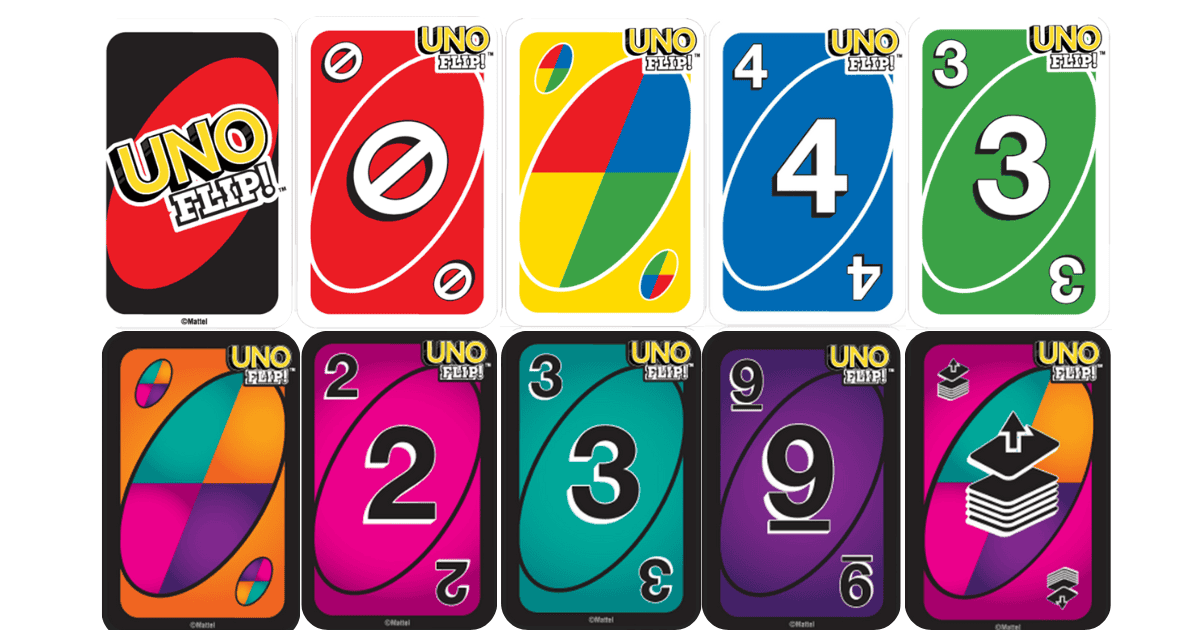
UNO Flip! Introduces a double-sided deck and new, aggressive action cards, fundamentally altering the game’s strategy.
Dual-Sided Action Cards
UNO Flip! Retains the core Skip, Reverse, and Wild cards on both sides, but introduces new penalties:
- Light Side Cards: Include the Draw 1 (+1) and the Wild Draw 2.
- Dark Side Cards (High Penalty): Includes the Draw 5 (+5), Skip Everyone, and the severe Wild Draw Color (next player draws cards until they hit a chosen color).

Core Gameplay & Winning
- Setup: The game begins and is played on the Light Side (white border). All cards in players’ hands, the Draw Pile, and the Discard Pile are Light Side up.
- The Flip Mechanic: When a Flip Card is played, the entire deck (Discard Pile, Draw Pile) and all players’ hands must be flipped over immediately to the opposite side (the Dark Side). Play continues on the new side until another Flip card is played.
Flip Example: The Discard Pile shows a Red 5 (Light Side). Player A plays a Red Flip card. All hands and decks are flipped to the Dark Side. The Discard Pile is now showing a Pink 5, and play continues with the Dark Side rules.
- Winning: As with Classic UNO, the round ends as soon as a player plays their last card. Draw penalties still apply to the next player even if the round is over.

UNO Show ’Em No Mercy
This variant combines all the popular house rules with extreme penalties, making it the most aggressive version of the game. This is the most ruthless version, featuring 168 cards, official stacking, and player elimination.

Core Gameplay & Winning
- Stacking Rule (Official!): Draw cards (+2,+4,+6,+10) can be stacked. You must play a Draw card of equal or higher value than the last one played. The first player unable to match or exceed the value takes the accumulated penalty.
Stacking Example: Player A plays a +2. Player B plays a +4 on it. Player C must now draw 6 cards (or play a +6 or +10 card to continue the stack). - Scoring — Elimination Bonus: If you cause a player to be eliminated by making them draw 25+ cards, you immediately score 250 points. The overall game win score is 1000 points.
- Winning: You win by either emptying your hand first or by being the last player remaining after everyone else has been eliminated by the Mercy Rule.

Clarification for the most debatable action in No MERCY:
1. If your last card is a 0 (0’s Pass)
- You play the 0 card.
- You win the round.
- The 0’s Pass action (all players pass their hand in the current direction of play) does not take effect, as the game round has ended.
2. If your last card is a 7 (7’s Swap)
- You play the 7-card.
- You win the round.
- The 7’s Swap action (swap your hand with another player of your choice) does not take effect, as the game round has ended. You have no hand to swap.
The only time a last card’s action must be resolved is with Draw cards (Draw 2, Draw 4, Wild Draw 6, etc.), where the next player must still take the penalty cards, and the value of those cards counts toward their final score for the round. The 0 and 7 cards do not involve drawing a penalty.
Clearing Up Misconceptions: The Official Verdict

Conclusion: Choosing Your UNO Experience
The UNO universe has expanded far beyond the initial 108-card deck, giving players a true choice in the kind of game they want to play. Knowing the official rules set for each variant is the key to minimizing arguments and maximizing fun.
Here is a quick guide to help you choose your next game night champion:
- The Purist: Choose UNO Classic for fundamental strategy, card counting, and mastering the crucial Wild Draw 4 challenge rule.
- The Strategist: Choose UNO Flip! for mid-level complexity by forcing players to manage two hands and time the use of the Flip Card perfectly.
- The Chaos Lover: Choose UNO Show ’Em No Mercy for maximum punishment, player elimination, and the intense strategic layer of official stacking.
The journey from a simple color-and-number-matching game to a high-stakes battle for survival is complete. You now have the definitive codex. Go forth, choose your version, and may your hand always be small when you finally yell, “UNO!”
UNO Trivia
- The Original Stack: The widespread popularity of “Stacking” Draw cards is a House Rule so common that Mattel officially adopted it for the first time in the UNO Show ’Em No Mercy variant.
- Saving Grace: The official rulebook states that a player can always choose not to play a playable card from their hand. They must instead draw a card, which is often used to save a valuable Wild card.
- No Mercy Points: The most direct way to win UNO Show ’Em No Mercy is not by emptying your hand, but by accumulating points from eliminating opponents. Causing an elimination is worth a massive 250 points, the equivalent of five standard Wild Draw 4 cards!
Resources:
Here’s the list of all the UNO rules documents for your reference:
- Uno Classic: https://service.mattel.com/instruction_sheets/uno%20basic%20is.pdf
- Uno Flip: https://service.mattel.com/instruction_sheets/GDR44-English.pdf
- Uno No Mercy: https://service.mattel.com/instruction_sheets/HVW18-Eng.pdf
- Uno Deluxe: https://service.mattel.com/instruction_sheets/43001%20Deluxe%20UNO.PDF
Disclaimer: This post may contain affiliate links. If you click and buy, we may receive a small commission at no extra cost to you. Read our full disclosure here.