
The Em Dash: From Literary Art to Algorithmic Habit
How AI Changed the Meaning of a Familiar Punctuation Mark

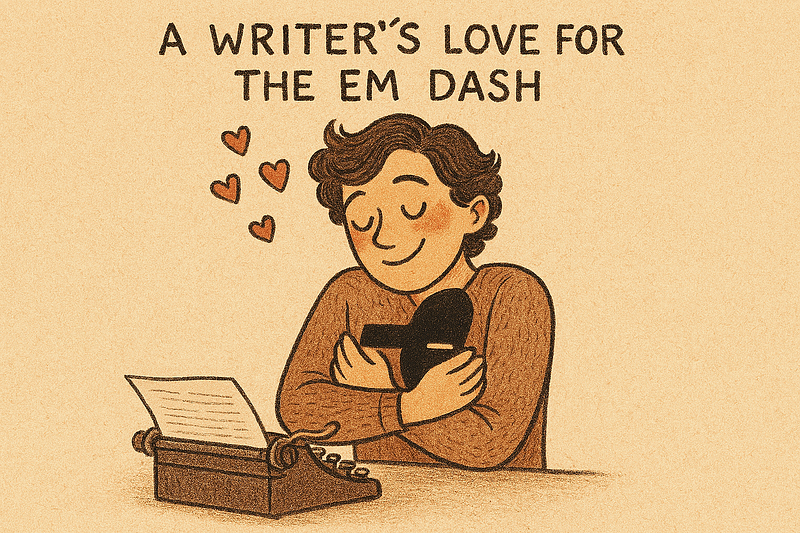
The best writers know the power of a single mark. We love the em dash ( — ). It’s not just punctuation; it’s a tool for injecting pure, spontaneous voice into your prose. The comma is too quiet, the semicolon too strict. The dash lets you seize control of the thought flow, the pause, and the punch. Virginia Woolf used it to map the exhilarating chaos of the human mind. Emily Dickinson used it to deliver a shocking emotional impact. It is, without a doubt, the most human tool in our kit.
Yet, this essential mark now signals the opposite. The feeling is one of betrayal.
Last year, I submitted an essay I wrote in 2018 to a Medium publication. It was a piece structured entirely by my human brain for a competition. But ironically, the editor’s AI-detection tool flagged it immediately: “High probability of AI generation.” The primary culprit? My intentional, frequent use of the em dash. (Read here)
It was funny yet weird. Imagine being a foundational mark of human style, created years before large models were commonplace, is now rejected as a machine’s signature. As professional writers, we must challenge this insult.
How did the AI steal our punctuation, and how do we take it back without just writing sloppy grammar?
Why Generative AI Overuses the Em dash
When an LLM uses the em dash, it’s not feeling inspired; it’s being statistically safe. This lack of conviction is why the imitation rings false.
Generative AI models operate by predicting the next most probable word or token. They analyze billions of high-quality human texts (literature, journalism, academic papers) where the em dash is used frequently and correctly as a sign of sophisticated prose. The AI, therefore, learns to associate the dash with “fluent, high-value content.”
The AI’s goal is to maintain coherence with the least possible semantic risk.
- Punctuation of Precision: Marks like the colon (:) and semicolon (;) are highly restrictive. They force the AI to encode a precise, logical relationship (e.g., introduction, list, balanced contrast). Choosing them requires high confidence in the detailed meaning.
- The Em Dash Escape: The dash is the punctuation equivalent of a shrug — a shortcut the AI exploits. It is the most flexible connector, a “get out of jail free” card that lets the model insert an aside or transition without committing to complex structural logic. It is the path of least resistance to sound smart.
- The Machine’s Use: It is driven by statistical safety, not meaning. The dash is the LLM’s path of least resistance to sound smart and keep the flow going.
The Uncanny Valley of Punctuation
This statistical overuse leads to the Uncanny Valley effect. The AI generates the dash flawlessly. Too flawlessly. It lacks the messy hesitation or unique rhythm that signals genuine human thought. A human writer’s pause is surprising, passionate, or reflective; the AI’s is clinical. The dash looks perfect, but it signals fluency without conveying any emotion. This is why the overuse instantly feels wrong to a discerning human reader. We recognize the mechanical beat where a human heartbeat should be.

The Great Debate: Style Guides
The dash has always been controversial, pitting the freedom of literary expression against the need for structural clarity. This is the debate that now defines our profession:
The Chicago Manual of Style views the dash as highly versatile, used to “signal an abrupt break in thought or an emphatic parenthetical expression.”It gives literary freedom and encourages its use for rhythmic and dramatic effect.
Microsoft Writing Style Guide cautions against overuse, warning that it can “interrupt the flow of the text and make sentences overly lengthy and complex.” For technical clarity, it limits its function almost exclusively to avoiding ambiguity.
For a novelist, the CMOS rule applies: Use the dash to follow your artistic impulse.
But for us, the technical communicators, the MWSG rule applies: the dash must be justified not by flair, but by function.

Reclaiming the Dash
We must use the dash with respect, reservation, and rigorous logic. To ensure your dash is a sign of human mastery, run this quick audit:
- The Confusion Litmus: Are you using the dashes in pairs to set off text that already contains internal commas, preventing mass confusion? If yes, use the dash—it’s essential for clarity. (This is the only time style guides universally agree on its necessity.)
Example: The project goals — speed, reliability, and low cost — were non-negotiable. - The Structure Test: Are you reaching for the dash because you dread deciding between a colon or a semicolon? Stop. The issue is a lazy structure. Fix the flow with a more precise mark.
- The Voice Override (The 1% Rule): Are you using it deliberately to inject a rare moment of fierce human critique or a crucial warning into an otherwise neutral text? (This is your signature moment. Make it count.)
- Informational Tip: When reviewing a dash-heavy draft, consider replacing dashes ( — ) with a single space. Read the sentence aloud. If the sentence still works perfectly, the dash was filler, and it must go.
The Real Defense of Human Voice
The true lesson of the algorithmic em dash isn’t just about grammar; it’s a profound challenge to human authorship. We cannot let the statistical probability of a machine define the standard for our craft. The goal isn’t to dumb down our writing to avoid the “AI accusation.” The true defense lies in intentionality and courage.
For the technical writers, this means treating the dash with respect and logic, ensuring our documentation is structurally unimpeachable.
For all writers and readers, the dash now serves as a powerful, immediate litmus test. If the content is riddled with stylish but unnecessary dashes, it signals a failure of commitment. The prose prioritizes statistical fluency over semantic precision.
The machine will always choose the path of least resistance. Our job is to select the path of maximum meaning. When an LLM uses the em dash, it’s a cold probability model working its shift. When you use the em dash, it is an act of declaration — a moment charged with the unmistakable precision, feeling, and soul that no algorithm can fake.
Let the algorithms churn out their perfect, probable dashes. We will keep the long, beautiful line — the one that still carries the sound of a human heartbeat.
Disclaimer: This post may contain affiliate links. If you click and buy, we may receive a small commission at no extra cost to you. Read our full disclosure here.