

OCD Is Not a Personality Trait, and It’s Time We Talked About That
A note before we begin: I am not a certified psychologist or therapist. Everything I write here is based on research, reading, and lived experience (mine and others’). If you think you or someone you know might be dealing with OCD, please reach out to a mental health professional. You deserve real support, not just a blog post.
Have you ever checked the stove five times before leaving the house, even though you know you turned it off? Washed your hands until they were raw because something just didn’t feel clean enough? Or had a thought so disturbing pop into your head, completely out of nowhere, that you felt ashamed of your own mind?
If any of that sounded familiar, keep reading.
OCD is one of the most misunderstood mental health conditions out there. And a big part of that misunderstanding comes from us. From the way we talk about it, joke about it, and casually toss the term around like it means nothing.
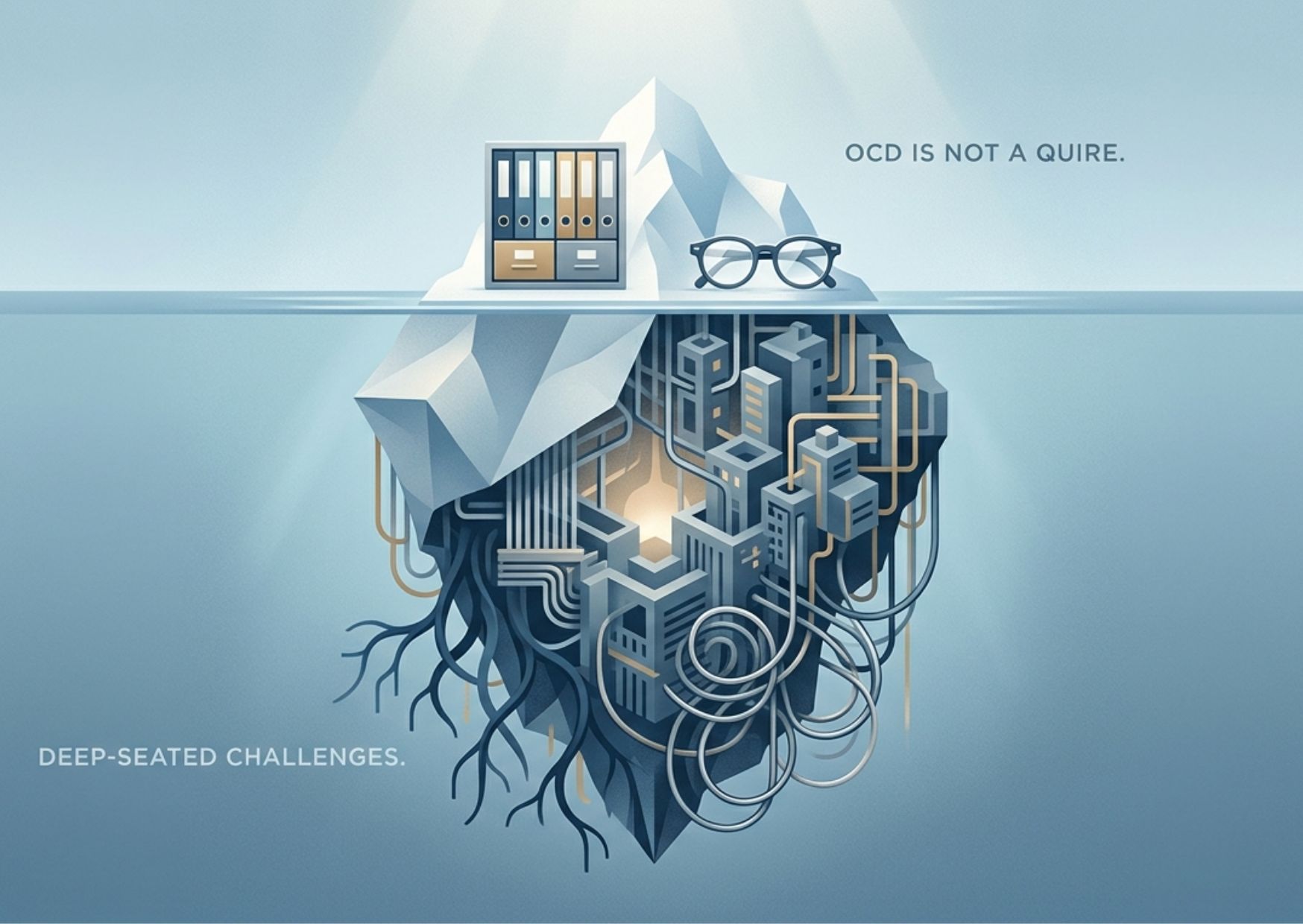
OCD is not a quirk. It is not a personality type. It is not something you “kind of have” because you like your bookshelf organised by colour.
It is a real, often exhausting mental health condition, and the people who live with it deserve more than a punchline.
So, what actually is OCD?
Obsessive-Compulsive Disorder is a mental health condition where a person experiences obsessions (unwanted, intrusive thoughts, images, or urges that cause real anxiety) and compulsions (repetitive behaviors or mental acts they feel driven to perform to reduce that anxiety).
The keyword here is unwanted. These thoughts aren’t things people want to think. They don’t reflect who someone is. They show up uninvited, and they refuse to leave quietly.
The cycle usually looks something like this: an intrusive thought arrives, anxiety spikes, the person performs a compulsion to get relief, the relief is temporary, and the thought comes back, often stronger.
It is exhausting. And it can take over entire days.
OCD is not about being a “neat freak” or liking things a certain way. In fact, many people with OCD have obsessions that have nothing to do with cleanliness or order at all. They might obsess over harm, religion, relationships, or their own identity. The compulsions aren’t always visible either. Some of them are entirely mental: repeating phrases silently, reviewing a situation over and over in your head, or seeking reassurance constantly from the people around you.
Intrusive thoughts: the part nobody talks about
I’ve had intrusive thoughts. Not in the clinical OCD sense, but in that 3 AM, completely irrational, where-did-that-come-from way. A sudden flash of a terrible scenario. A thought so strange or dark that my first instinct was why did I just think that?
And I remember the shame of it. The quiet, horrible feeling that having a thought like that said something terrible about me as a person.
It doesn’t. And it doesn’t for you either.
Intrusive thoughts (the kind that are unwanted, disturbing, and feel completely out of character) are something almost everyone experiences at some point. The difference with OCD is that these thoughts don’t pass. They get louder. They feel like threats. And the person experiencing them often gets trapped in a loop of trying to neutralize them, which ironically just gives the thoughts more power.
Intrusive thoughts in OCD can include:
- Fears of accidentally harming yourself or someone you love
- Violent or sexual images that feel horrifying to the person experiencing them
- Obsessive doubts (“Did I leave the gas on?” “Did I say something offensive?” “Am I actually a good person?“)
- Religious or moral fears
- The feeling that something terrible will happen unless a specific ritual is performed
These are not desires. They are not wishes. They are the mind misfiring, and they cause immense distress to the people who experience them.
Having an intrusive thought does not make you a bad person. It makes you human. The thought is not the problem. The shame we attach to it often is.
Why do people develop OCD?
Honestly, the full picture is still being researched. But what we do know is that OCD is likely caused by a combination of factors.
Neurobiological factors. There seems to be a connection between OCD and how certain brain circuits function, particularly those involving serotonin. The brain essentially gets “stuck” in a loop, unable to move past the intrusive thought, unlike most people’s brains.
Genetics. OCD does tend to run in families, though having a family member with OCD doesn’t mean you will develop it.
Environment and life experiences. Trauma, significant stress, or major life changes can trigger or worsen OCD symptoms in people who are already predisposed.
What’s important to understand is that nobody chooses this. Nobody sits down one day and decides to be anxious about whether they locked the door 19 times. OCD happens to people, and it is not a reflection of their intelligence, their character, or their strength.
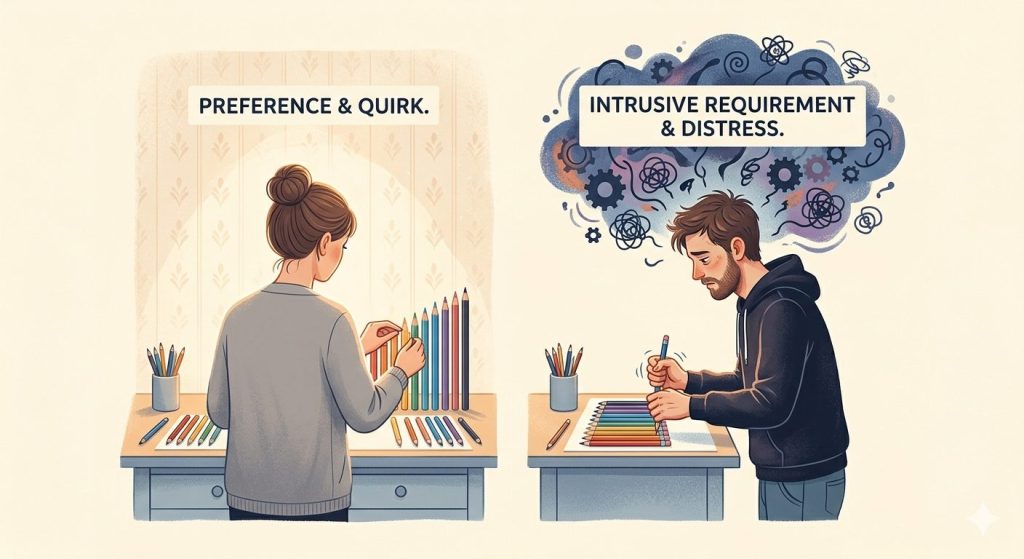
“But I’m so OCD about my desk.” Can we please stop?
This is the part I feel most strongly about, so bear with me.
We’ve turned OCD into a personality trait. A casual descriptor. A fun, relatable thing to say at brunch.
“Oh, I’m so OCD. I can’t stand when the cushions are crooked.” “I arranged my closet by color. I’m literally so OCD.”
I’ve said things like this. You probably have too. Most of us have, without thinking.
But here’s what that kind of language actually does: it reduces a debilitating condition to a preference for tidiness. It tells people who are genuinely struggling that what they’re experiencing is relatable and normal, so why would they need help? It makes it harder for someone with real OCD to speak up, because they’ve heard their condition described as a quirk so many times that they wonder if they’re being dramatic.
They’re not. They’re really not.
OCD, at its worst, can make it impossible to leave the house, maintain relationships, hold down a job, or get through a single hour without being hijacked by anxiety. It is not a preference for clean surfaces.
Being more careful with this language is a small thing. But small things add up, especially for people quietly suffering and wondering whether anyone will take them seriously.
Managing OCD: what actually helps
The good news (and I say this with genuine relief) is that OCD is treatable. It’s not a life sentence. With the right support, people with OCD can and do lead full, meaningful lives. Here’s what the research and the people who live with this say actually works.
Cognitive Behavioral Therapy (CBT)
This is usually the first thing a therapist will recommend, and for good reason. CBT helps you identify the thought patterns that fuel the OCD cycle and replace them with more realistic, grounded ones. It gives you actual tools, not just the instruction to “think positively.”
Exposure and Response Prevention (ERP)
ERP is a specific type of CBT that’s considered the gold standard for OCD. It works by gradually exposing you to the situations or thoughts that trigger your obsessions, while helping you resist the urge to perform the compulsion. It sounds simple. It is not easy. But it is remarkably effective, and most people who complete it see significant improvement.
Mindfulness
This one isn’t a cure, but it is a genuinely useful practice alongside therapy. Mindfulness teaches you to observe your thoughts without engaging with them: to notice the intrusive thought, acknowledge it, and let it pass without treating it as a command or a threat. For people with OCD who feel completely at the mercy of their thoughts, this shift in the relationship with the mind can be powerful.
Medication
For many people, medication (particularly SSRIs, which stand for selective serotonin reuptake inhibitors) makes a significant difference. SSRIs don’t eliminate OCD, but they can reduce the intensity and frequency of obsessions enough that therapy becomes more effective. Medication is not a weakness. It’s a tool, like any other.
One important note: please don’t try to self-diagnose or self-medicate based on anything you read here. A proper diagnosis from a psychiatrist or psychologist is the right starting point. What works for one person may not work for another, and treatment should be tailored to you.
If this is you, or someone you know
If you’ve been reading this and something has clicked, if you’ve recognized yourself or someone close to you, I want to say this carefully and clearly:
You are not broken. You are not scary. You are not your thoughts.
OCD is a condition, not a character flaw. And like any condition, it responds to treatment. The hardest part, as with so much in mental health, is often just taking the first step: admitting that what you’re experiencing is real and that you deserve help for it.
Talk to a doctor. Look for a therapist who specializes in OCD and ERP. Reach out to someone you trust. You don’t have to have it all figured out before you ask for help.
And if you’re not sure whether what you’re experiencing is OCD at all, that’s okay too. A professional can help you figure that out. What matters is that you don’t sit alone with it.
You are not defined by what you think. You are defined by how you choose to face it.
I would love to hear from you in the comments. Have you or someone you care about experienced OCD? Has this post shifted anything for you? Let’s have the conversation that many people are afraid to start.
Disclaimer: This post may contain affiliate links. If you click and buy, we may receive a small commission at no extra cost to you. Read our full disclosure here.