

Read, Don’t Drown: A Smart‑Notes System That Keeps the Joy
A gentle, no-fuss way to carry the best lines out of the water and actually use them later.
You know that feeling when you close a self-help book, sigh happily, and a week later, your memory is a polite fog. The quotes are somewhere in your digital highlights. The ideas are somewhere in your head. But neither shows up when you actually need to make a decision or write a sentence.
I used to be a highlight hoarder. I would finish a brilliant book, look at my forty yellow-streaked pages, and feel like a scholar. But a month later, I couldn’t tell you a single thing I’d actually changed. I had a library of highlights and a life of the same old patterns.
This isn’t a productivity manifesto. It’s the opposite. It’s a lightweight rhythm that respects two non‑negotiables:
- Reading should feel like reading, not admin work.
- Future You should find what you need in under 30 seconds.
The Logic: A Plate Balanced in One Hand
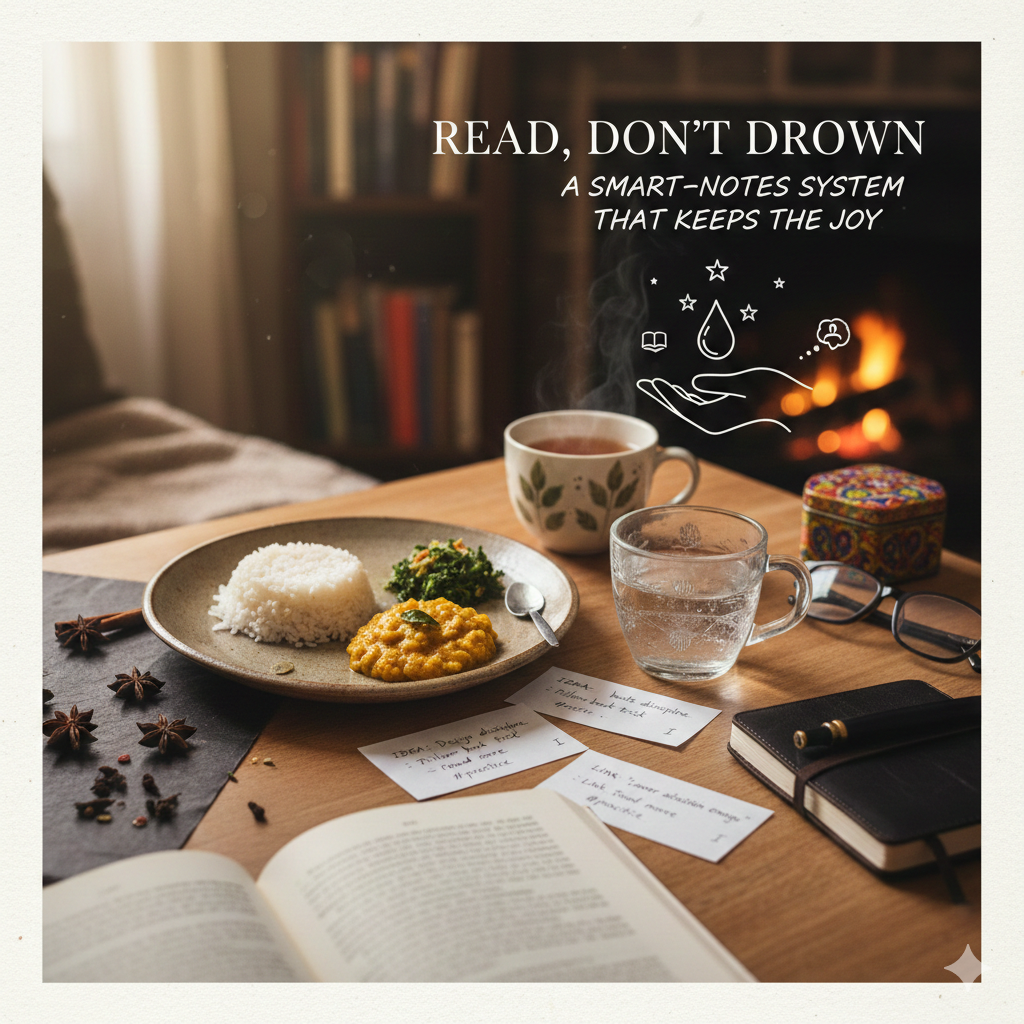
Think of this as a traditional Indian recipe for your books: distinct parts, clean flavors, everything mixed only when you eat. In a traditional meal, you don’t mash everything into a paste before you start; you keep the sambol, the curry, and the rice separate until the bite.
Your notes should work the same way.
We aren’t building a “vault” or a “second brain” that requires a manual to operate.
We are just creating four simple moves that keep the ideas fresh without making them a chore.
Step 1: Mark, Don’t Map
The biggest mistake we make is turning reading into a job. When we start “mapping” a book — trying to capture every sub-point — we kill the flow. We stop being readers and start being court stenographers.
Stay in the story. Keep the on‑page noise low. Highlight only what genuinely pulls you, and add a tiny margin cue for context:
- I = Insight (A new way of seeing)
- Q = Question (Something to research)
- T = Tactic (Something to do)
At the end of the chapter or your session, pause. Before the coffee gets cold, write three smart notes. Not ten. Three.
The Smart Note Format:
- Idea: (In your own words, no quoting allowed)
- So what: (Why does this matter to your life or work?)
- Link: (A project, a person, or another idea)
By moving from ink to meaning while the idea is still warm, you internalize the thought.
You aren’t just saving a file; you’re changing your mind.
Step 2: Tag with Intent (Keep them scarce)
The “Tag Soup” is where systems go to die. If you have fifty tags (#interesting, #cool, #books), you have zero tags. Scarcity forces clarity. Limit yourself to five “Mega-Tags” across your entire system.
Try these:
- #practice — Something to try.
- #reference — Definitions or models to cite.
- #story — Anecdotes worth retelling.
- #craft — Techniques to reuse.
- #theme — Big, abstract ideas (Focus, Grief, Belonging).
Add one micro‑action if it applies. Write: “Test for 7 days” or “Share with Rhea.”
Action is the best glue for memory.
Step 3: Connect Sparingly
Connections are the spice. Use them, but don’t drown in them. You don’t need a complex web of “backlinks” to be effective. Aim for just one “win” per note.
Is there a Project link? (“Use this for my morning routine post.”)
Is there an Idea link? (“Rhymes with ‘environment beats willpower’ from Book A.”)
Is there a Person link? (“Send to Sangeetha before our 1:1.”)
If you can’t find a link immediately, don’t sweat it. You can always add more later. The goal is flow, not perfection.
Step 4: Review Tiny on a Schedule
This is the “Sunday Date.” Set a 10‑minute appointment with your notes. Coffee or tea helps; a quiet room helps more.
Skim the week’s smart notes. Star one to use next week, and archive the rest. No perfection spirals needed. Once a month, spend 20 minutes compiling your starred notes into a “mini issue”: three ideas, one action, one story.
Suddenly, you don’t have a pile of random thoughts; you have a ready stack of material for your next blog, talk, or life decision.
A Worked Example: The Habit Shift
Imagine you’re reading a book on habits. A line lands: “Make the good habit obvious and the bad habit invisible.” You highlight it. Margin cue: I.
The Smart Note:
- Idea: Design beats discipline. I’ll put tonight’s book on my pillow every morning.
- So what: Removes end‑of‑day friction.
- Link: #practice. Try for 7 days. Pairs with “lower activation energy” note from last month.
This is not a summary. It’s a nudge that changes your next day.
Yes, This Works for Fiction
Fiction doesn’t need to be “used” in the traditional sense, but it deserves to be remembered with precision. When a scene in a novel makes your chest tighten, don’t just move on. Capture the why.
- Craft: “The author reveals backstory through arguments, not flashbacks. Borrow this.” (#craft)
- Theme: “Loneliness as a form of self‑protection.” (#theme)
- Resonance: “Why did that dinner scene ache? Because everyone spoke around the truth.” (#story)
Three notes. Close the book. Keep the spell.
The Two-Week Experiment
Books don’t owe us productivity. They offer company and ways of seeing. This system is just a gentle cup, something to carry the water without spilling the joy.
If you’re ready to try it, start tomorrow.
Week 1: Read as usual, but end each session with three smart notes. On Sunday, highlight your favorite.
Week 2: Do the micro-action attached to that highlight. Share one note with a friend.
By the end of the fortnight, you’ll realize you aren’t just reading more — you’re seeing more.
Disclaimer: This post may contain affiliate links. If you click and buy, we may receive a small commission at no extra cost to you. Read our full disclosure here.