
Why True Success Demands the Patience of the Hunter!
You rarely see the crane rushing. Its patience reflects that true success demands stillness and focus, much like the hunter waiting for the right moment to strike. That is true success.
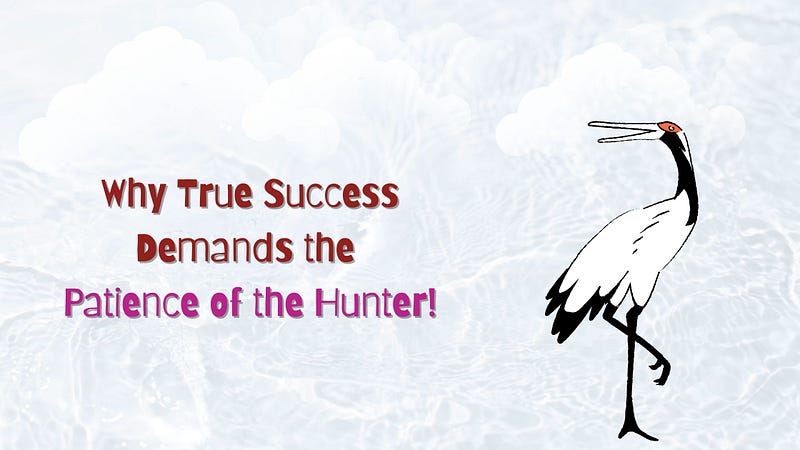
You rarely see the crane rushing. If you observe one for a few minutes, you might think it’s doing nothing at all. It stands, often on one leg, a portrait of stillness. It is the very definition of patience, an almost motionless sentinel. Yet, this apparent inactivity is, in fact, the most intense form of action.
It is observing.
It is gathering intelligence.
For hours, sometimes days, it studies the subtle shift of the current, the shadow of a passing cloud, the near-imperceptible ripple that betrays the presence of its prey. When the strike finally comes, it is breathtakingly fast, exact, and rarely wasted. The crane’s success is not born from energy, but from pre-emptive observation.
This simple, elegant lesson from the wild holds profound power, both for how we manage our careers and how we manage our own minds. In a world that constantly rewards urgency and reaction, true mastery belongs to those who possess the crane’s gaze.
The Hidden Power of Seeing in the Professional World
For years, I believed that professional success was about volume. Sending more emails, attending more meetings, and speaking up as often as possible were the keys to showing your visibility. We mistake busyness for impact. But I began to notice a subtle difference in the truly effective leaders and team members; they were often the quietest in the room. They weren’t talking; they were watching.
In professional life, observation is a strategic superpower.
When I started working with teams, one of my early mistakes was reacting immediately to every perceived fire. A team member would express anxiety about a deadline, and I would jump straight into solution mode. Over time, I have been learning to pause. I have started practicing the crane’s discipline. I observe the environment before striking with a solution.
- Did the team member just need to vent, or did they need a resource?
- Was the anxiety rooted in the deadline itself, or in an unspoken conflict with a collaborator?
- Was the whole team showing the same subtle signs of burnout (quiet meetings, delayed replies) that pointed to a deeper structural issue?
The crane doesn’t strike at the first ripple; it strikes when the target is perfectly exposed. Similarly, the best leaders don’t immediately solve the stated problem; they observe the system around the issue. They watch for non-verbal cues in negotiation, listen for the intent behind a customer’s complaint, and pay attention to what the market is doing silently before launching a major shift.
This deep observation allows for precision leadership, intervening exactly where and when it matters, and nowhere else.

Mastering the Inner Landscape
If observation is critical for external success, it is absolutely foundational for internal peace. When we fail to observe, we live purely in reaction. A rude comment from a colleague triggers instant anger; a setback at work triggers a spiral of self-doubt.
I remember a period where I felt constantly overwhelmed. Every afternoon, my mood would crash, making it impossible to focus. My initial, reactive response was to chug more tea or try to power through. It wasn’t until I decided to treat my internal self with the same objective focus as a crane gives the water that I found the root cause.
I started to observe my energy patterns without judgment:
- When did the drop happen? (Always 30 minutes after lunch.)
- What was I consuming? (A carb-heavy meal.)
- What thought patterns preceded the burnout? (Usually worrying about the next day’s workload.)
By simply observing my thoughts and habits, by becoming the detached sentinel of my own mind, I have started creating a space between the feeling (overwhelm) and the reaction (more tea or coffee).
This is the essence of mindfulness. We become the observer of our thoughts, realizing they are just ripples on the surface, not the solid reality of the water itself. This personal discipline allows us to regulate emotions, identify destructive patterns, and replace brute-force striving with quiet, targeted effort.
From Seeing to Truly Observing
In a noisy, demanding world, the greatest competitive advantage and personal asset you can cultivate is the deliberate pause. It is the quiet commitment to look longer and listen deeper.
The crane does not observe to pass the time. It observes to ensure the success of the eventual action. It teaches us that patient attention is not a passive luxury, but the ultimate precursor to precise, effective, and efficient movement.
To begin mastering the crane’s gaze, try this simple experiment today.
For the subsequent three conversations you have, reduce your own talking time by half. Instead, focus entirely on observing the other person’s body language, their hesitations, and the emotion in their voice. You’ll be stunned by the amount of intelligence you suddenly gain.
Stop reacting to the ripples.
Start observing the system.
Your next great success is waiting for you to be still enough to see it.
Disclaimer: This post may contain affiliate links. If you click and buy, we may receive a small commission at no extra cost to you. Read our full disclosure here.