Writers Are Intentionally Lowering Their Quality Because of AI Detectors
And honestly, I am not okay with AI being the judge of creativity.
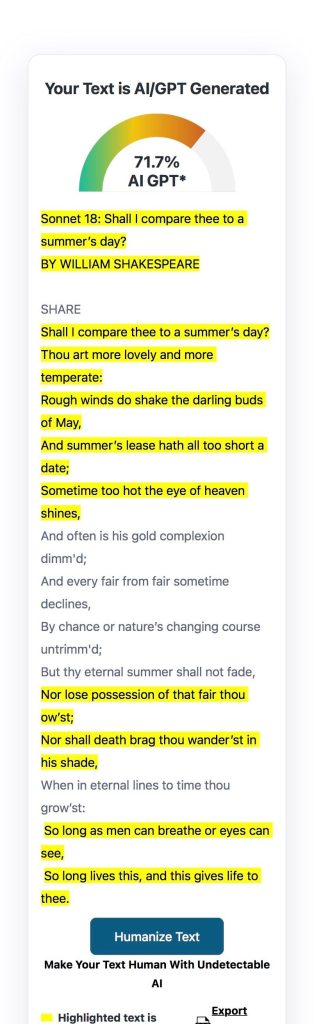
Recently, someone on LinkedIn put a Shakespeare sonnet through an AI detector. This was not a blog post or a Medium article. It was a sonnet from the 1600s, written by someone who lived long before electricity, let alone large language models.
The detector labeled it as 100% AI-written.
I looked at that post for a full minute. At first, I laughed, but then I stopped.
That story is funny until it isn’t. It stops being funny the moment you realize that the same tools making that absurd call are now sitting in the inboxes of editors, publications, and platforms. They are quietly making decisions about real writers and real work. In fact, a recent report found that more than half of large publishing platforms now use at least one AI detection tool in their review process.
Even smaller websites and individual editors are adopting these detectors to keep up. The spread is fast and growing. What began as an experiment is quickly turning into the default.
I know this because it happened to me too.
While these steps are great for creating authenticity and ownership, are they really accurate and helpful for finding authentic writers?

When Your Best Work Gets Flagged as Fake
A while back, I submitted an article to a Medium publication. It was not a new piece, but something I had written long before anyone talked about AI writing tools. That article had even won an award. The publication responded and said it was 60% AI-generated.
Think about that number for a moment. Sixty percent. This was work I had put time, thought, and effort into, that existed before the tools they were using to check it even existed. And honestly, I wouldn’t have shared it with the publication, even if it were a new blog. I was confident about the blog, and I knew I had enough to show my ownership, just in case.
I felt angry, insulted, and honestly, a bit heartbroken. What made it worse was how they handled it. There was no conversation, no questions about how I wrote it, and no request for a draft history or a Google Docs version. Just a decision, given out like a parking ticket.
I offered to show them the Google Docs version history and explained that I had used Grammarly for editing, just as any careful writer would. Still, there was no response.
Medium, the platform I wrote on and truly enjoyed, has been doing the same thing to writers, running content through detectors and making decisions that have real consequences for people whose only mistake was writing clearly. And Medium is far from alone. Major platforms like Substack, Wattpad, and even some mainstream news outlets have adopted similar detection practices.
The reach goes beyond a single site or genre; whether you are publishing fiction, essays, or investigative journalism, AI detectors are becoming routine in the submission process. For writers everywhere, it is starting to feel like the new normal.
The Shakespeare Problem Nobody Is Talking About
This is what AI detectors actually do. They look for patterns like sentence rhythm, word choice, and structure. The problem is, good writing has always had those qualities. That is what makes it good.
Shakespeare wrote in iambic pentameter, a style that is clean, rhythmic, and structured. Now, that seems suspicious.
A well-edited article with a steady tone and clear sentences is also seen as suspicious.
A writer who has spent years building a clear, precise voice is now considered very suspicious.
The detectors are not really finding AI. They are picking up on competence. Somehow, that’s become acceptable.
Honestly, AI-generated content is a real problem. Publications are overwhelmed, and editors are exhausted. The concern is real.
But the solution we have now is to use an unreliable tool on human work and let it decide who is telling the truth. That is not a real solution. It is just a shortcut pretending to be one. There are better ways. If we care about real voices, we could combine human review with technology, letting editors check the version history or request notes on the writing process.
Writers should have a chance to appeal a flag, explain their choices, or show proof that their work is original. Most importantly, these tools should be transparent. People deserve to know how decisions are made, not just get a number with no explanation. Any system that affects real people and real work should have real oversight and allow for conversation.
Writers Are Now Self-Editing Out of Fear
This is the part that keeps me up at night.
A copywriter recently admitted something that I cannot stop thinking about. She said: “I caught myself deliberately choosing a less elegant sentence structure because I was worried the better version would make people suspicious.”
Read that again.
A professional writer, choosing weaker words on purpose. Not because they fit the piece, but because the better words might get her flagged.
I have not done this yet, but I can feel it. That small voice shows up when I write something clean and wonder, “Will someone think a machine wrote this?” It is new. It started in the last year or so, and it does not belong there.
This is what AI detection has really created. Not a cleaner internet. Not more authentic content. Just writers second-guessing themselves, cutting back their own work before anyone else can.
We spent years finding our voice, developing a style, learning when to use a short sentence for impact, and when to slow down and let a paragraph breathe. Now, after all that work, a percentage score decides if any of it matters.
The Absurdity Is Escalating, and Nobody Is Laughing
Let us just follow this logic to where it leads.
If elegant writing is suspicious, writers will make their work less elegant. If a steady tone is a red flag, writers will deliberately introduce inconsistency. If a clean structure looks like a machine, writers will break it to seem more human.
We are basically being asked to act in a messy way. To create imperfection just to prove ourselves.
That is not writing. That is just putting on a show.
The strange part is that AI tools keep getting better every month. The pattern detectors that look for today will be gone from the models tomorrow. So writers will keep chasing a moving target, making their work simpler to match yesterday’s idea of what sounds human, while real AI content quietly moves ahead.
The writers lose. The detectors stay profitable. The AI keeps improving. Everyone claps.
What We Actually Deserve
Here is what I think should happen instead.
Publications that care about authentic content should talk to their writers. Ask questions. Request draft histories. Look at writing over time, not just one article. Build relationships with contributors instead of entrusting a tool that flagged Shakespeare.
But writers are not powerless here. There are things we can do to protect our work and push for fairer practices. You can keep detailed version histories or save drafts that show your writing process, so you have proof if your work gets flagged. If someone asks about your writing, do not hesitate to share your process, your notes, or even samples from earlier in your career. If you get a rejection or an AI flag that seems wrong, ask for clarification and push for clearer, more transparent review processes. And if you have a platform, use it to talk about these problems. The more we speak up, the harder it is to ignore the real impact these tools have on authentic writing.
Using Grammarly is not cheating. Editing is not cheating. Having a clean, professional voice you built over the years is not cheating. If those things count against you, the system is broken, not the writer. And I am not saying I don’t use AI. I use it extensively for brainstorming ideas, reviewing my articles and blogs, improving SEO, proofreading, and ensuring it follows the style guide I have created to keep my tone consistent, etc.
I brought proof: version history, a track record, and an award. And I still had to fight to be believed. That should not happen to any honest writer. It creates a chilling effect that is already changing how people write, what they submit, and whether they even try.
The Sentence I Am Still Proud Of
I want to finish on a note of honesty. I have not started writing badly on purpose. Not yet.
I still write the way I always have. I still look for the clearer word, the tighter sentence, the structure that helps the reader.
But now I notice it. When a paragraph comes out clean, I feel a small, silly flicker of worry instead of the satisfaction I used to have. That feeling is new. I did not have it before, and I resent it. AI did not steal my job. It did not write my articles. But it did, quietly and without asking, plant a seed of doubt in a place that used to feel safe. The place where I trust my own voice.
We are writers. We have always been the most human thing in the room. Now, having to prove it again and again to a tool that cannot tell us apart from a 400-year-old sonnet is no small thing.
It is something worth being angry about. It is worth writing about, too.
If this has happened to you, or if you have felt that creeping doubt, I want to hear about it in the comments. You are not alone, and the more we talk about it, the harder it is to ignore. If you have found ways to push back, protect your work, or keep your writing confidence despite all this, please share those strategies too. Your experience and advice could help someone else keep their voice strong.
For more posts on AI writing, see our other posts, AI Myths Every Professional Should Stop Believing In 2026
Disclaimer: This post may contain affiliate links. If you click and buy, we may receive a small commission at no extra cost to you. Read our full disclosure here.