
How I think about money now versus how I thought about it at 25.
I want to start with a number. When I was 25, there was a salary figure in my head. A number that felt so far away it was almost fictional. The kind of money I would think about quietly, alone, and then push aside because wanting it too badly felt dangerous. Like it might jinx something.
I earn more than that number now.
The biggest surprise wasn’t reaching that number. It was realizing that getting there didn’t feel the way I expected. The moment itself was quieter than the journey. Along the way, almost everything I believed about money changed.
This isn’t advice on how to get rich. I’m not a financial advisor, and I don’t want to pretend to be. I just want to share honestly how my relationship with money has changed, because I think many people in their late 20s and 30s are going through something similar, but it’s rarely discussed openly.
Where I started
I grew up in a financially humble family. Money was not an abstract concept in our house. It was what determined whether things were okay or not. You learn that quickly as a kid, and it stays in your body long after the circumstances change.
At 25, I was freelancing, switching jobs, doing whatever it took to earn more. Not for myself, not really. For my family. Every financial decision I made was filtered through one question: how does this help them? I would not spend on myself without guilt. A new pair of shoes felt like a betrayal of something. A meal out felt like a leak in a system that could not afford leaks.
I saved a lot, but it wasn’t a strategy. It was more like hoarding water in a drought driven by fear, not planning.

The first thing that changed: I started to count myself in
At some point, and I cannot tell you exactly when, I realized that I had completely excluded myself from my own financial planning.
Everything was for my family, for the future, for emergencies that had not happened yet. I was treating my own needs and desires as optional line items that could always be cut. And I had been cutting them for so long that I had almost forgotten they existed.
What really changed things for me was seeing people from similar backgrounds start to allow themselves small comforts and invest in their own lives without guilt. It made me realize that what I thought was a noble sacrifice was just an old habit I’d never questioned.
I still support my family, and that won’t change. But now, I make sure to include myself in the budget too. If I wear myself out caring for everyone else, I can’t really help anyone.
The second thing that changed: money stopped being the only measure of everything
When I was 25, I truly believed money was the main thing you needed to get by. It wasn’t everything, but it solved most problems and opened most doors.
That belief has softened considerably.
Money does matter. I want to be clear about that, because I don’t like when people say “money isn’t everything” just to dodge the real issues. Money is important, especially if you grew up without enough. Financial stability isn’t a luxury; it’s the base you build on.
But I have watched people with significant money be miserable, and I have watched people with modest incomes build genuinely rich lives. The variable that seems to matter more than the amount is the relationship. How you think about it, how you talk about it, whether you are making intentional choices or just reacting to it.
The people around me changed my view on this more than any book or article ever could. Being close to people with a healthy, balanced approach to money showed me it was possible for me, too.
The third thing that changed: what financial freedom actually means
When I was younger, I thought financial freedom meant never checking price tags. I imagined a day when I’d have so much money that prices wouldn’t even matter.
I do not believe that anymore.
What I’ve learned is that the more you earn, the more you want. The price tag never really goes away; it just shifts. As you get used to spending on some things, new, bigger expenses take their place.
Now, financial freedom for me means covering my basic needs without stress, not losing sleep over bills, and having a buffer for tough months. Real freedom is about security, not endless wealth.
Noticing the price tag isn’t a failure. The real goal is to reach a place where basic living costs no longer feel scary.
How I actually manage money now
I use a spreadsheet. It might sound boring, but it’s one of the most helpful things I do each month. If spreadsheets aren’t for you, there are easy budgeting tools or simple Google Sheets templates online. The main thing is to pick something you’ll actually use to track your spending.
Each month, I review what I spent, what I saved, and what’s coming up. It’s simple and doesn’t need a finance degree, just the habit of honestly checking where your money goes. That clarity alone changes your decisions.
Here is how I think about my money now. I have categories that are non-negotiable:
Emergency fund: This one is not optional. In the world we live in, with layoffs across industries and inflation rising consistently, an emergency fund is not a nice-to-have. It is a basic act of self-protection. A good rule of thumb is to aim for an emergency fund that covers three to six months of your essential expenses. That way, if you lose your job or face an unexpected crisis, you have a real buffer to fall back on while you figure out your next step. Even if you can only put 100 rupees in it this month, put 100 rupees in it. The amount matters less than the habit. Start with whatever is possible and build up from there.
Vacation fund: Travel isn’t a luxury for me. It is something that keeps me sane and gives me perspective. I intentionally save for it rather than spend whatever is left over at the end of the month.
Investments: Even small ones. Something going toward the future, consistently.
Guilt fund: This one is important, and I want to talk about it properly.
The guilt fund
I set aside a part of my budget called the guilt fund. It’s money I let myself spend on anything I want, no explanations needed, not even to myself.
I love food. A significant portion of my guilt fund goes into restaurants, trying new cuisines, and indulging in gourmet treats, without a second thought. I have zero regrets about it.
The idea behind the guilt fund is simple: if you never let yourself have anything, you’ll eventually spend impulsively. The guilt fund is a way to spend on yourself without guilt or going overboard. You’re just being honest about having wants, and those matter too. As a guideline, you could set aside 5 to 10 percent of your income for this. Adjust the amount as needed, but having a rough number makes it easier to stick to.
But there is a discipline to it, too. If I buy something for myself this month, I try not to do the same next month. Not because I am punishing myself, but because I am asking myself a genuine question before I buy something: Do I actually need this right now? Is this my guilt spending for the month, or am I just buying it without thinking?
The real problem is buying without thinking, not the act of buying itself.
The thing I want to say to anyone who thinks they cannot afford to save
People have told me, “You earn well now, so you can do this.” I get why they say that. Sometimes, saving just isn’t possible; every rupee is already spent, or an emergency wipes out your savings. Some months, the numbers just don’t add up, and I want to acknowledge that. But it’s not always about the amount. Even the smallest savings habit, when you can manage it, makes a difference over time.
When I took home 12,000 rupees a month and paid 6,000 in rent, I still managed to save a little from what was left. Sometimes it was just 100 rupees, but I put something away every month.
That is not a savings strategy, it’s a habit. Once you build that habit, it grows with you. The number doesn’t matter as much as doing it every month, before you spend the rest. are. With what you have. The core message: focus on building the saving habit, not the size of the amount. The amount will grow. The habit is what matters.
What I focus on now
Today, my financial life centers on three things: saving, traveling, and not having to stress about basic needs.
That last one sounds simple, but it took years to get there. Not having to calculate whether I can afford groceries or whether getting sick this month will derail my finances is the version of financial freedom I actually wanted. I just did not know how to name it at 25.
I am not done. I have things I still want to build toward, goals I have not reached, and things I want to be able to do for the people I love that I cannot quite yet. Finance is a continuous thing, not a destination.
But shifting from seeing money as something to fear to seeing it as a tool happened quietly in my 30s. It came from earning more, learning more, and most of all, thinking more carefully about what I wanted to build.
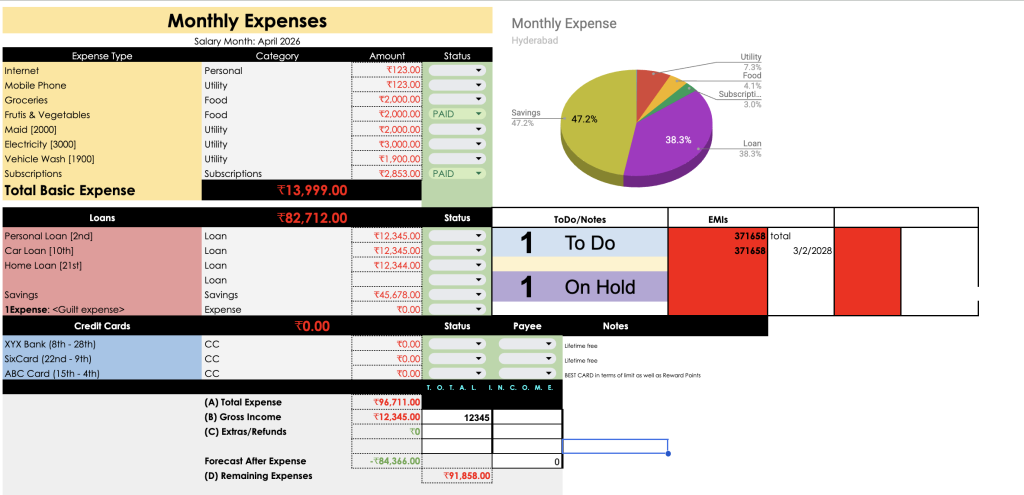
This screenshot shows the finance management sheet my partner and I created to map our current and future expenses! You can create something similar based on your requirements and your expenses.
Everyone’s financial situation is different. Your expenses, your family, your responsibilities, your starting point, none of these are the same as mine. I am not here to tell you what to do with your money.
But the one thing I believe applies regardless of where you are: savings are non-negotiable. Whatever the amount. Whatever the month. Something, always.
Start with that. Build from there. The rest usually falls into place.
How has your relationship with money changed compared to a few years ago? I’d really like to know. If you’re willing, share a moment, story, or challenge that changed how you think about money. Did something make you see your finances differently? Was there a fear, lesson, or habit you had to let go of? Share your story in the comments. Your experience might help someone else in a similar spot.
These posts might also be useful: The Problem With Financial Self-Help Books (And What Actually Works Instead) and 5 Reasons Why You Should Read Atomic Habits.
Disclaimer: This post may contain affiliate links. If you click and buy, we may receive a small commission at no extra cost to you. Read our full disclosure here.